EN
EN


When sourcing melamine boards or PETfaced boards, many overseas furniture importers and project purchasers often focus on surface patterns and finishes while overlooking the choice of substrate. When selecting melamine boards, buyers often struggle to decide between particleboard or MDF. Even with the same surface finish, pressing it onto particleboard versus MDF results in significant differences regarding the finished board's stability, machinability, cost, and suitability for specific applications. Choosing the wrong substrate can lead to a host of postsales issues, such as warping, edge chipping, and swelling due to moisture.
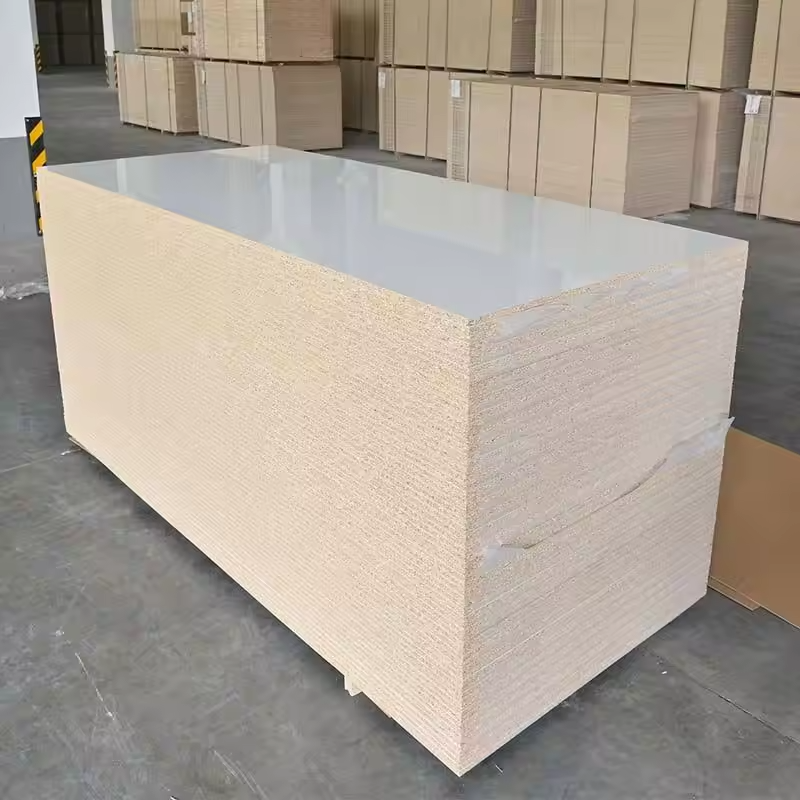
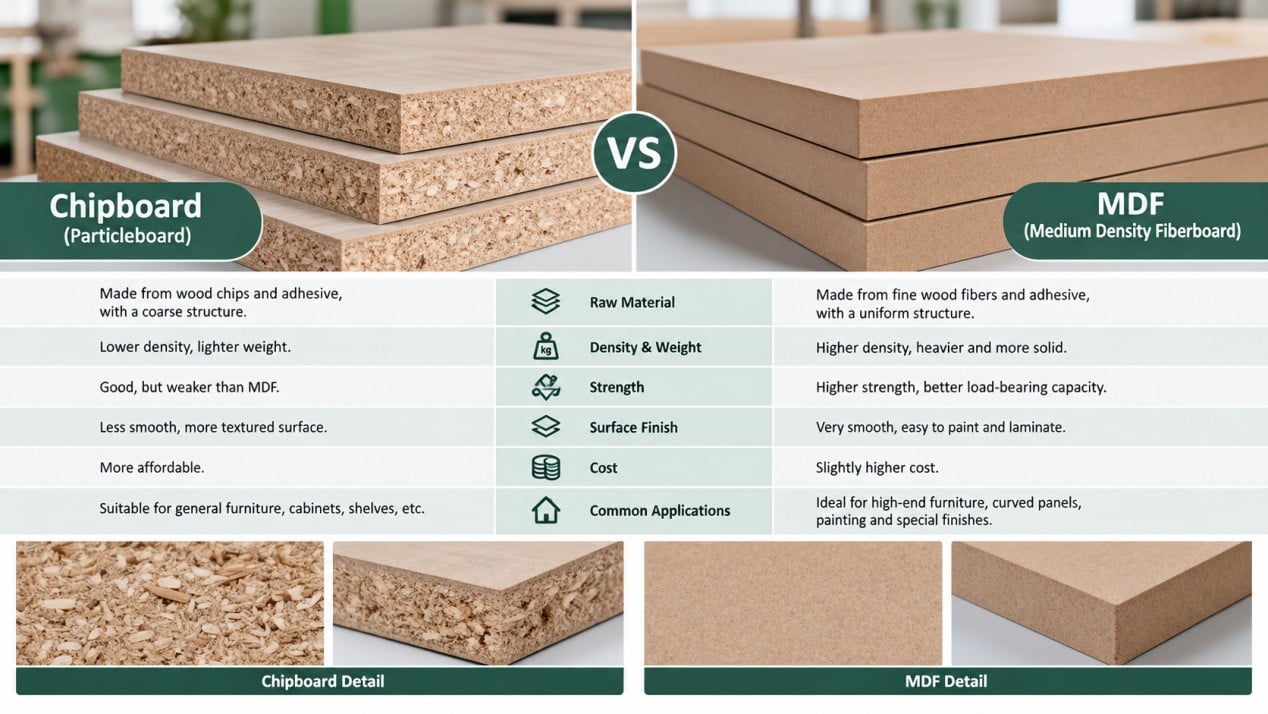
Particleboard is manufactured by hotpressing wood chips mixed with adhesive, resulting in an internal structure of interlocking particles. Its advantages include balanced internal structural stress—making it resistant to warping or bending—and high costeffectiveness, making it ideal for largescale commercial furniture orders; moistureresistant variants also perform well in hot, humid environments. Its drawbacks include a tendency for particles to dislodge or edges to chip during drilling or cutting if the tools are not sufficiently sharp, as well as unsuitability for complex machining operations such as intricate profile routing or deep carving.
Common Misconceptions In The Procurement Market
Misconception 1: MDF is inherently superior to particleboard. Many buyers automatically assume that MDF is a premium material. In reality, there is no absolute "better" or "worse"—it depends entirely on the specific application. Particleboard is perfectly adequate for simple flat door panels and cabinet carcasses, whereas MDF is the preferred choice for door panels featuring intricate carvings or profiles.
Misconception 2: Surface finishes can compensate for substrate defects. Whether it is PET or melamine, the finish serves only as a surface protective layer and cannot alter the physical properties of the substrate itself. If the substrate lacks inherent stability, even a superior finish cannot prevent the board from warping or swelling due to moisture absorption.
Misconception 3: Placing orders based solely on price without inquiring about the substrate type. Problems often arise only after delivery, when it is discovered that the substrate is incompatible with the factory's processing equipment or the project's operating environment, resulting in significant losses.
This decorative boards substrate comparison covers core performance indicators, and it introduces different PET boards substrate options for furniture production.
| Item | ParticleBoard | MDF |
| Price | Lower cost, costeffective for bulk orders | Relatively higher price |
| Weightbearing | Good screwholding capacity | Medium load capacity, smooth surface |
| Machinability | Suitable for cabinet frame cutting | Excellent for fine carving & profiling |
| Moistureresistance | Moistureresistant grades available | Prone to water swelling |
Here Are Four Practical Procurement Tips For Overseas Buyers
First, clearly specify the required substrate type—particleboard or MDF—at the initial inquiry stage. Do not simply ask for "melamine board" or "PET board"; even with the same surface finish, differences in the substrate lead to significant variations in performance and pricing.
Second, select the substrate based on your factory's processing capabilities. If your facility primarily performs simple cutting and drilling with minimal intricate routing or carving, particleboard is a suitable choice. However, if the product requires extensive shaping or milling, MDF is recommended.
Third, consider the project's operating environment. Both substrates are suitable for dry, inland climates; however, for highhumidity regions—such as Southeast Asia or coastal areas—moistureresistant particleboard is the preferred choice, while standard MDF should be used with caution.
Fourth, verify the substrate during the sampling phase. Ensure that the substrate used in the sample matches that of the final bulk order to avoid discrepancies where the sample and the massproduced goods utilize different materials.
Both particleboard and MDF have their respective pros and cons; there is no single "universal" substrate. Refer to this export furniture boards substrate guide and pick the proper particleboard MDF substrate for melamine PET boards. Only by carefully weighing processing conditions, the usage environment, and your budget can you select the right substrate for your decorative boards and minimize postsales risks.
If you are sourcing melamine or PET decorative boards, please share details regarding the application scenario, processing methods, and target market. Zhenshijie can recommend the ideal substrate solution and provide samples for your evaluation and testing.
 Hot News
2026-09-17
2026-09-14
2026-09-11
Shandong Zhenshijie — China's trusted manufacturer of PET & melamine veneer panels for cabinets, kitchens & furniture. MDF, plywood, particleboard & more — custom sizes, textures & finishes.
located north of Xiaowan Line, Tanyi Town, Feixian County, Linyi City, Shandong Province.
Copyright © 2026 Shandong Zhenshijie International Trade CO,. LTD All rights reserved. Privacy Policy