EN


 In commercial environments such as laboratories, data centers, electronics workshops, and display counters, static electricity is an often-overlooked issue that poses significant risks. At the very least, electrostatic discharge (ESD) attracts dust, causing surfaces to become soiled and difficult to clean; in more severe cases, it can directly damage sensitive electronic components. When sourcing custom commercial furniture, many overseas procurement professionals prioritize material anti-static performance. Melamine-faced boards and PET-faced panels—the two most common choices—are frequently compared in this regard.
It is important to clarify one point: standard melamine boards and conventional PET-faced boards do not inherently possess anti-static properties. Whether a board meets anti-static requirements depends on factors such as the surface finish formulation, the inclusion of anti-static additives, the choice of substrate, and the surface treatment process—not merely the category of the board itself. The market generally offers standard versions, custom-made conductive versions, and long-lasting anti-static versions. Many buyers fall into a common trap by judging performance solely based on the product name, only to discover during on-site inspection that the specifications fail to meet the required standards.
Melamine-faced boards are produced by hot-pressing impregnated paper. Standard versions exhibit high surface resistivity—acting as insulating materials—and are highly prone to static electricity accumulation in dry environments. For anti-static requirements, specialized impregnated paper treated with anti-static agents must be used, alongside strict control over temperature and humidity during production.
While these boards offer the advantages of a stable supply and high cost-effectiveness—making them well-suited for large-scale commercial cabinetry—they have a notable drawback: the anti-static additives in the surface layer can gradually deplete due to repeated wiping and long-term wear, leading to a progressive decline in anti-static performance. This degradation is even more pronounced in lower-cost, modified board products.
PET-faced panels perform differently. Compared to melamine-impregnated paper, PET film is less prone to the continuous buildup of static electricity. In anti-static PET film, conductive agents are uniformly incorporated into the film layer, creating a stable, conductive pathway. Unlike modified anti-static melamine panels, anti-static PET features a dense surface that withstands various cleaning agents; the conductive components are not easily washed away, ensuring more stable performance over long-term use. This makes it highly suitable for environments that require frequent cleaning, such as electronics workshops or testing workstations. However, it also has notable drawbacks: the raw material for anti-static PET is more expensive, there are fewer design options available, and lead times for large orders tend to be longer.
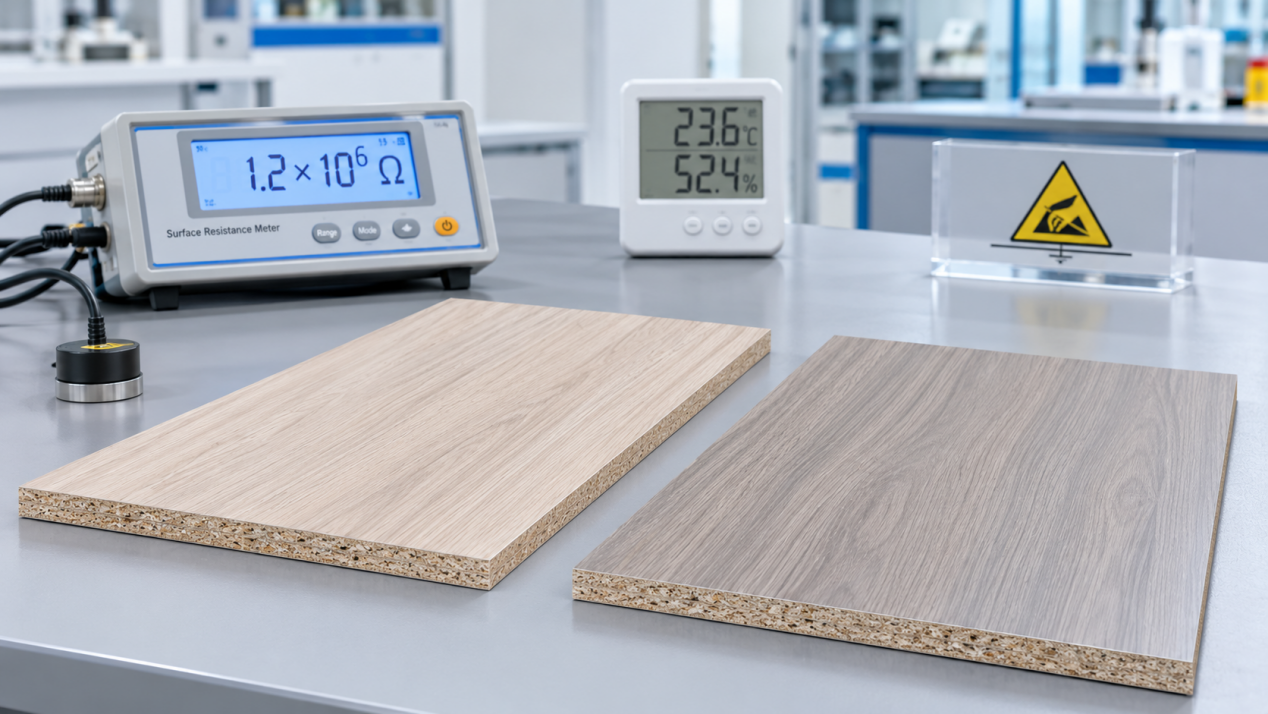
When engaging with overseas projects, do not rely solely on verbal claims of "anti-static" properties; ensure that specific surface resistivity standards are explicitly defined in the contract. For electronics projects in Europe and the U.S., a surface resistivity range of 10⁶–10⁹ Ω is typically required—values that are too high fail to provide adequate protection, while values that are too low may cause excessively rapid static discharge. Furthermore, always request third-party test reports to distinguish between materials with a temporary, surface-applied anti-static coating and those with long-lasting, inherently modified properties. Materials that rely solely on a surface coating will lose their effectiveness after just a few cleanings, making them unsuitable for long-term commercial applications.
Selection can be categorized based on the intended application: for standard offices or display cabinetry—where there is no requirement for precision electronic protection—conventional panels will suffice. For workstations in electronics workshops, chip storage cabinets, or furniture for server rooms, anti-static PET-faced boards with inherent material-level anti-static modification are the preferred choice. If the budget is limited and the primary goal is simply to reduce dust accumulation—with less stringent requirements for anti-static performance—then modified melamine board would be a more suitable option.
Ambient humidity also affects anti-static performance. Even with compliant anti-static panels, the anti-static capability will drop significantly if the on-site humidity remains below 40% for an extended period. When communicating with overseas clients, in addition to recommending specific panels, you might also advise them to monitor and control environmental humidity—a proactive step that can help avoid future customer complaints.
In short, neither type of board is inherently superior; the choice ultimately depends on project acceptance criteria, budget, and the intended service life. For applications requiring long-term stability and frequent cleaning, anti-static PET boards are the preferred option. Conversely, for large-volume orders with tight budgets and less stringent anti-static requirements, modified melamine boards are more suitable. As a supplier of boards for export, confirming testing standards with clients in advance and ensuring the alignment of quality inspection documentation is essential to avoid disputes during the acceptance phase and to successfully secure orders for commercial furniture in overseas markets.
 Hot News
2026-11-01
2026-10-29
2026-10-25
2026-10-22
Shandong Zhenshijie — China's trusted manufacturer of PET & melamine veneer panels for cabinets, kitchens & furniture. MDF, plywood, particleboard & more — custom sizes, textures & finishes.
located north of Xiaowan Line, Tanyi Town, Feixian County, Linyi City, Shandong Province.
Copyright © 2026 Shandong Zhenshijie International Trade CO,. LTD All rights reserved. Privacy Policy